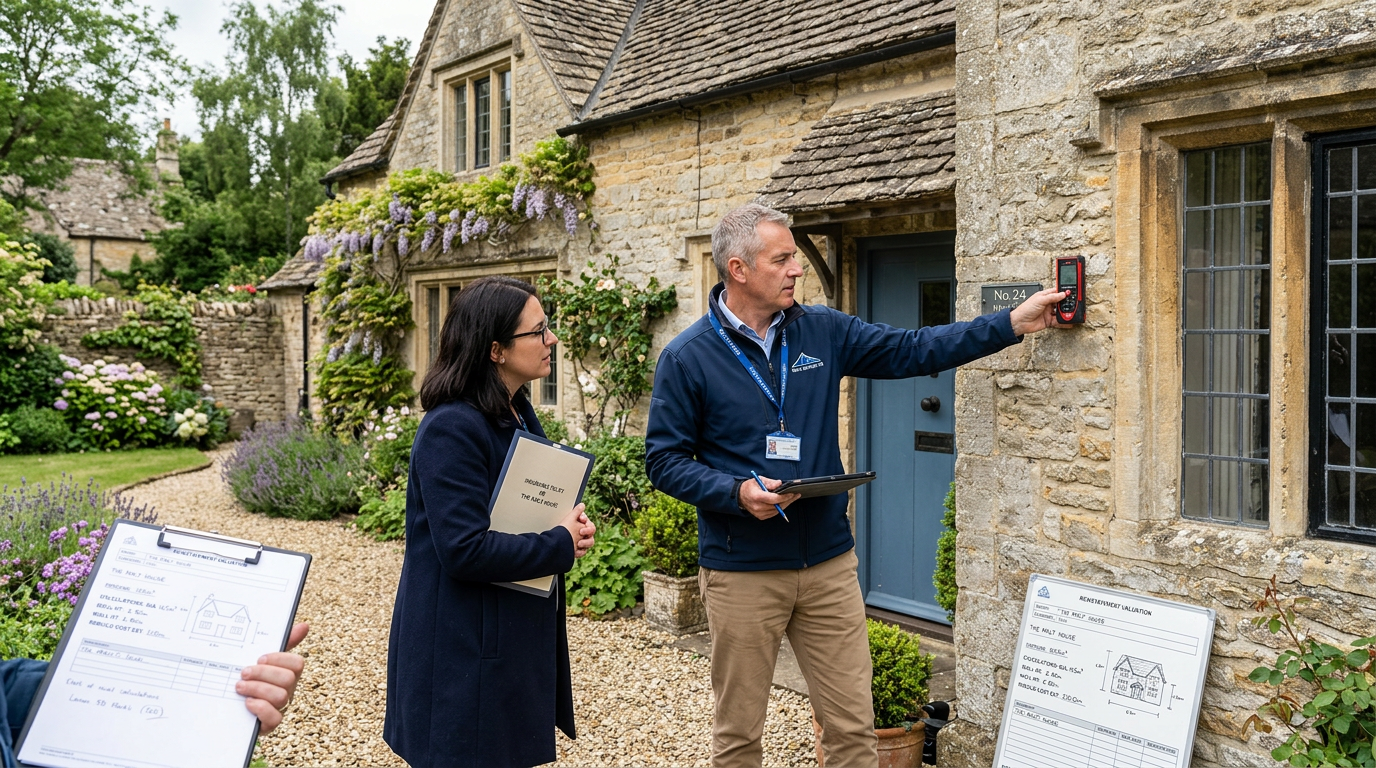
If your home was destroyed tomorrow — by fire, flood or a catastrophic structural failure — would your buildings insurance actually cover the full cost of rebuilding it? For many homeowners across Crawley and West Sussex, the honest answer is no. And most of them don't realise it until it's too late.
A Crawley Surveyors providing insurance reinstatement valuations can help you understand the true rebuild cost of your property, so you can set your buildings insurance sum insured at the right level. In this guide, I'll explain what an insurance reinstatement valuation is, who needs one, and what happens when homeowners get it wrong.
What Is an Insurance Reinstatement Valuation?
An insurance reinstatement valuation — sometimes called a rebuild cost assessment or day one reinstatement valuation — is a professional calculation of how much it would cost to completely rebuild your property from scratch, following a total loss.
This is fundamentally different from the market value of your property. The market value includes the land — which cannot be destroyed and therefore doesn't need to be insured. The reinstatement cost covers:
- Demolition and site clearance
- Professional fees (architects, structural engineers, project management)
- Building materials at current prices
- Labour costs
- Local authority fees and statutory compliance costs
- Site insurance and temporary accommodation costs if applicable
For most homes in Crawley and the surrounding areas, the rebuild cost is significantly different from the market value — sometimes higher (in lower-value areas where property prices don't reflect construction costs), sometimes lower (in prime London commuter villages where land value inflates market prices).
Why Do So Many Homeowners Get It Wrong?
The most common route to under-insurance is simple: homeowners use the market value of their home as the buildings insurance figure. It feels logical — if the house is worth £400,000, insure it for £400,000. But this is almost always incorrect.
There are three typical scenarios I see when carrying out reinstatement valuations in West Sussex:
Scenario 1: The Under-Insured Owner
This is the most dangerous scenario. The homeowner has insured their property for, say, £350,000. The actual rebuild cost turns out to be £520,000. In the event of a total loss, they face a shortfall of £170,000 — and their insurer may apply a proportionate reduction to all claims, even partial ones, under the "average" principle. A flood claim for £50,000 of damage might result in a payout of only £33,600.
Scenario 2: The Over-Insured Owner
Less dangerous financially, but a waste of money every year. If your insurer-provided rebuild cost estimate is inflated — which can happen with online calculators that don't account for local variations — you may be paying premiums on coverage you don't need.
Scenario 3: The Property That Hasn't Been Reassessed in Years
Building costs have risen sharply since 2020. A reinstatement valuation that was accurate in 2019 may be significantly out of date today. Construction material costs increased by over 30% between 2020 and 2024, and labour costs in the South East have risen considerably faster than general inflation.
Real Case Study
A client in Worth, Crawley, came to us after a serious kitchen fire. Their buildings insurance was set at £280,000 — the figure their estate agent mentioned when they bought the property in 2018. The actual rebuild cost assessment we carried out put the figure at £415,000. Their insurer invoked the average clause, and their claim for £85,000 of fire damage was reduced proportionately. They received just over £57,000 — leaving them to fund £28,000 of repairs themselves. A reinstatement valuation at the time of purchase would have cost them around £250 and taken less than a day.
Who Needs an Insurance Reinstatement Valuation?
The short answer: every property owner. But certain situations make it especially critical:
- Owners of older or unusual properties — Victorian and Edwardian properties in Crawley, traditional Sussex flint buildings, timber-framed cottages and listed buildings all have specialist construction that dramatically increases rebuild costs
- Anyone who hasn't reviewed their buildings insurance for 3+ years — given construction cost inflation since 2020
- Landlords and buy-to-let investors — especially those with multiple properties or HMOs
- Commercial property owners — mixed-use buildings, offices and retail premises require specialist assessment
- Anyone using a self-set insurance sum rather than an insurer's calculator
- Leaseholders with a share of freehold — responsible for arranging buildings insurance on the whole block
Listed Buildings and Non-Standard Properties
For listed buildings — of which there are several in the Crawley area and many more across the wider West Sussex and Surrey countryside — the reinstatement cost is almost always substantially higher than for a comparable non-listed property. Listed buildings must be repaired and restored using traditional materials and techniques that are significantly more expensive than modern alternatives.
A Georgian farmhouse near Horsham, for example, might have a market value of £1.2 million but a reinstatement cost of £2.5 million, simply because it would need to be rebuilt using lime mortar, traditional brick-making, oak beams and period joinery — all of which carry a premium.
The RICS Reinstatement Cost Assessment Standard
Professional insurance reinstatement valuations are carried out in accordance with the RICS Reinstatement Cost Assessment (RCA) standard. This ensures that the surveyor:
- Physically inspects the property (not a desktop estimate)
- Measures and records all relevant features
- Uses current building cost data (typically from BCIS — the Building Cost Information Service)
- Applies appropriate regional cost adjustments for the South East
- Provides a documented report that insurers can rely upon
Our valuations are RICS-regulated and carried out by qualified chartered surveyors, giving you and your insurer full confidence in the resulting figure.
How Much Does a Reinstatement Valuation Cost?
For a standard residential property in Crawley, an insurance reinstatement valuation typically costs between £200 and £500 depending on the size and complexity of the property. For larger, more complex or listed buildings, fees will be higher.
When you consider that under-insurance can result in shortfalls of tens or even hundreds of thousands of pounds, the valuation fee is genuinely one of the best investments a property owner can make. It's also a one-off cost — most surveyors recommend reassessment every three to five years, or following significant alterations to the property.
What Happens During the Inspection?
When we carry out a reinstatement valuation, we'll spend between one and two hours at your property depending on its size. During this time we'll:
- Measure the footprint, height and all above-ground floor areas
- Note the construction type, age, materials and any non-standard features
- Record all outbuildings, garages, boundary walls and other insurable structures
- Note any extensions, conservatories or alterations
- Assess any particular features that influence cost — decorative brickwork, period features, specialist glazing, unusual roofing materials, etc.
After the inspection, we prepare a detailed report calculating the rebuild cost using current BCIS data, adjusted for regional factors in West Sussex and Surrey. The report is typically delivered within five working days.
What About New-Build Properties in Crawley?
New-build properties in Crawley — particularly those in developments around Forge Wood and Northgate — often come with a developer-provided reinstatement cost figure. In our experience, these figures are sometimes accurate, but they can quickly become outdated as construction costs rise.
If you bought a new-build in Crawley three or more years ago and haven't reviewed your buildings insurance since, it's worth checking whether that original figure still applies. We offer portfolio reviews for landlords and investors with multiple new-build properties across the Crawley area.
Internal Linking
For more information about our services, see our full guide to surveying services in Crawley. If you're buying a property and need a building survey explained, we cover that in detail elsewhere on the blog. You may also be interested in our guide to RICS Red Book valuations, which covers formal valuations for other purposes.
Frequently Asked Questions
How often should I get a reinstatement valuation?
RICS recommends reassessment every three to five years, or sooner if there have been significant alterations to the property or major changes in construction costs. Given recent inflation in building costs, if you haven't had a valuation since before 2021, it's advisable to have one carried out now.
Is an online rebuild cost calculator good enough?
Online calculators (such as the ABI's Building Cost Information Service calculator) can be a useful starting point, but they don't account for the specific features of your property. Non-standard construction, period features, listed status, or unusual materials all require a professional assessment to be accurately priced. For most standard properties, a calculator can give a reasonable ballpark, but only a physical inspection provides certainty.
What is the "average" clause in buildings insurance?
The average clause is a provision in most buildings insurance policies that allows the insurer to reduce a claim payout proportionately if the property is found to be under-insured. So if your sum insured is 70% of the true rebuild cost, the insurer may pay only 70% of any claim — not just total loss claims, but partial damage claims too. This is the primary risk of under-insurance.
Does the reinstatement cost include the land value?
No. The reinstatement cost (and therefore your buildings insurance sum insured) should never include the land value. Land cannot be destroyed, so it doesn't need to be insured. Including land value is one of the most common reasons for over-insurance. This is why the reinstatement cost is almost always different from — and usually lower than — the market value of a property in a sought-after area.
Do I need a reinstatement valuation for a leasehold flat?
If you own a leasehold flat, the responsibility for buildings insurance usually rests with the freeholder or the management company. As a leaseholder, your service charges will include a contribution towards the buildings insurance premium. If you are part of a residents' management company or share of freehold arrangement, you may be responsible for arranging buildings insurance on the whole block — in which case a professional reinstatement valuation for the entire building is strongly recommended.
Get a Reinstatement Valuation in Crawley
Don't leave your most valuable asset improperly insured. Our qualified Crawley surveyors provide RICS-standard insurance reinstatement valuations for residential and commercial properties across West Sussex, Surrey and the South East. Contact us today for a free, no-obligation quote.