There's a common assumption that a Crawley Surveyors is only needed for older properties. After all, if a house is brand new, what could possibly be wrong with it? The answer, in my experience, is: quite a lot. New builds are not immune to defects — and in many cases, they're more likely to have hidden issues than a well-maintained older property.
A professional snagging survey — carried out before or shortly after you move into a new build home — is one of the smartest investments a buyer can make. In this guide, I'll explain what a snagging survey involves, what we commonly find, and why the developer's own sign-off process is simply not enough.
What Is a Snagging Survey?
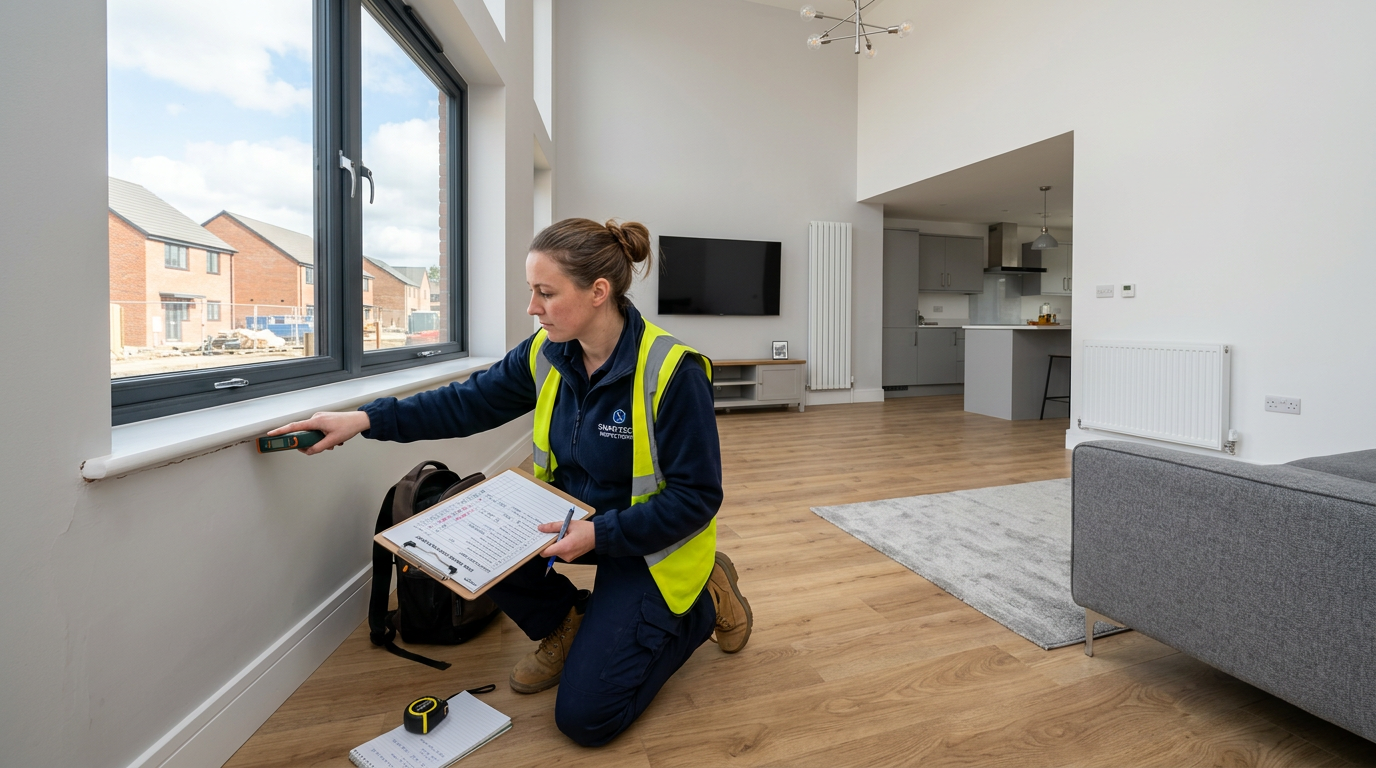
A snagging survey is a detailed inspection of a newly built or recently completed property, designed to identify defects, unfinished work and items that don't meet the required building standards or the developer's own specifications. The resulting report — the "snag list" — is then presented to the developer so they can carry out the necessary remedial work before or shortly after completion.
Snagging surveys are distinct from standard RICS building surveys, which are designed for second-hand properties. A snagging inspection focuses specifically on the quality of workmanship, completeness of finishes, compliance with building regulations, and any items that fall short of what was promised in the purchase specification.
Why Can't I Trust the Developer's Own Inspection?
Every housebuilder carries out their own internal quality checks before handing over a property. This is a legal requirement. So why do you need your own independent survey?
Because the developer's quality control team is employed by the developer. Their primary interest is in completing and handing over properties on time — not in identifying every minor (or major) defect on your behalf. In a busy development, properties are often inspected quickly by teams under pressure to hit completion targets.
In our experience surveying new builds across Crawley and the Forge Wood development in particular, the average snagging list contains between 40 and 150 individual items. Many of these are minor cosmetic issues. But a significant proportion — typically 10–20% — are genuine construction defects that could become expensive problems if not addressed promptly.
Real Case Study — Forge Wood, Crawley
We carried out a snagging survey on a four-bedroom detached house in the Forge Wood development in late 2025. Our report identified 87 snag items, including: inadequate cavity wall insulation in two sections of the external wall, a first-floor bathroom drain that wasn't properly connected (discovered by running water — a test the developer hadn't performed), missing fire stops in the loft around the party wall, and poorly fitted double-glazed units with visible seal failures in three windows. The developer carried out all remedial works within six weeks of receiving our report. The cost of the snagging survey was £450. The cost of the works we identified — if left unaddressed and fixed by the owner later — would have been over £8,000.
What Does a Snagging Survey Cover?
A thorough snagging survey covers every visible and accessible element of the property. This typically includes:
- External fabric: Brickwork and mortar joints, rendering, windows and doors (fit, seals, operation), roof tiles and flashings, guttering and downpipes, driveway and paths
- Internal structure: Wall plumb and floor levels, door and window operation, staircase fixings and balustrade compliance
- Finishes: Plastering quality, paint coverage, tiling (bathrooms, kitchen), flooring installation, joinery and skirting boards
- Kitchens and bathrooms: Appliance installation and operation, plumbing connections, silicone sealing, extractor fan installation and ducting
- Services: Heating system commissioning, hot and cold water flow, electrical sockets and switches (tested), consumer unit labelling
- Roof space: Insulation coverage and depth, ventilation, structure, fire stopping at party walls
- Drainage: Visible external drainage runs, gully positions, water test of all sanitary ware
When Should I Get a Snagging Survey?
Ideally, a snagging survey should be carried out before legal completion — i.e., before you take ownership and hand over the remaining purchase funds. This gives you maximum leverage with the developer to require remediation before you move in.
In practice, many developers resist allowing independent surveyors access to properties before completion. If your developer takes this position, you should:
- Request access in writing, citing your right under the Consumer Code for Housebuilders
- If access is denied, arrange the survey for the day of legal completion — before you sign off
- If already completed, arrange the survey as soon as possible — ideally within the first two weeks. Most new build warranties (NHBC Buildmark, Premier Guarantee etc.) require you to report defects promptly
The two-year period following completion is particularly important — this is when most housebuilder warranties require the developer to fix defects at their own cost. After two years, you move into the structural warranty period (typically 8–10 years for major structural issues only), and minor defect claims are no longer the developer's responsibility.
Common Defects We Find in Crawley New Builds
Based on our surveys across Crawley's newer developments — including Forge Wood, Maidenbower and Three Bridges — here are the most frequently occurring snag categories:
- Missing or incomplete cavity wall insulation (found using thermal imaging)
- Inadequate loft insulation coverage — often thin or missing around eaves
- Poorly fitted windows — stiff to operate, gaps in seals, condensation between panes
- Drainage issues — blocked or incorrectly laid external drains, slow-draining baths/showers
- Cracked plaster — often at wall/ceiling junctions or around window openings
- Missing fire stops at party walls in loft spaces (a building regulations non-compliance)
- Poor tiling and grouting in bathrooms — cracked tiles, incomplete grout lines, missing silicone at junctions
- Paintwork defects — runs, missed areas, poor coverage on doors and skirting boards
Does the NHBC Warranty Replace the Need for a Snagging Survey?
No. The NHBC Buildmark warranty (or equivalent from Premier Guarantee, LABC etc.) provides important protection against major structural defects and against the developer going bust before completion. But it is not a quality inspection service.
The NHBC does inspect properties during construction — but their inspectors visit infrequently and cannot check every detail of every unit. The warranty is a safety net, not a quality guarantee. Your snagging surveyor is your eyes and ears at the property level.
For more on what surveys are available, see our guide to building surveys and our comparison of survey levels. You may also want to read about how thermal imaging helps find hidden defects.
Frequently Asked Questions
How much does a snagging survey cost in Crawley?
For a typical two- to four-bedroom new build in Crawley or the surrounding area, a professional snagging survey typically costs between £300 and £550 depending on property size. Larger detached houses or those with garages and landscaping will be at the higher end. Contact us for a fixed-fee quote based on your specific property.
Can I do my own snagging inspection?
You can — and many buyers do make their own notes before moving in. However, a professional surveyor will identify technical defects that most buyers wouldn't notice: incorrect floor levels, missing fire stops, inadequate insulation, service installation errors. DIY snagging catches cosmetic issues; professional snagging catches the things that really matter.
What if my developer won't fix the snags?
If your developer refuses to address legitimate snag items, you have several options: escalate through the developer's formal complaints process, refer the matter to the New Homes Ombudsman (if the developer is a member), make a claim under your NHBC or other warranty, or — for significant defects — take legal advice. A professional snag report from a RICS-regulated surveyor is strong evidence in any dispute.
Is it too late to get a snagging survey if I've already moved in?
No — as long as you're within the two-year developer liability period (from legal completion), it's not too late to have a snagging survey and require the developer to fix defects. Many buyers don't instruct a survey until they've lived in the property for a few months and started noticing issues. Even then, a professional report helps you compile a comprehensive list and negotiate effectively with the developer.
Do you use thermal imaging for snagging surveys?
Yes. Thermal imaging is particularly valuable for snagging surveys during the cooler months, as it allows us to identify missing or incomplete cavity wall insulation and cold bridging defects that are completely invisible to the naked eye. We include thermal imaging as standard on all snagging surveys carried out between October and April.